
“Revealed Truths: Scientific Wonders in the Quran That Defy Time”
Introduction
The Quran is a book revered not only for its spiritual guidance but also for its profound references to the natural world. These verses, often poetic and metaphorical, contain layers of meaning that have fascinated both theologians and scientists for centuries. In the modern age, many have begun to see these verses through a new lens—recognizing them as reflections of scientific truths that were only discovered centuries later. This interplay between scripture and science offers a unique opportunity to explore how the Quran harmonizes spiritual insight with natural reality.
In this blog post, we explore some of the most remarkable miracles of nature as described in the Quran and examine them through the lens of contemporary scientific knowledge.
1. The Expanding Universe
Quranic Verse
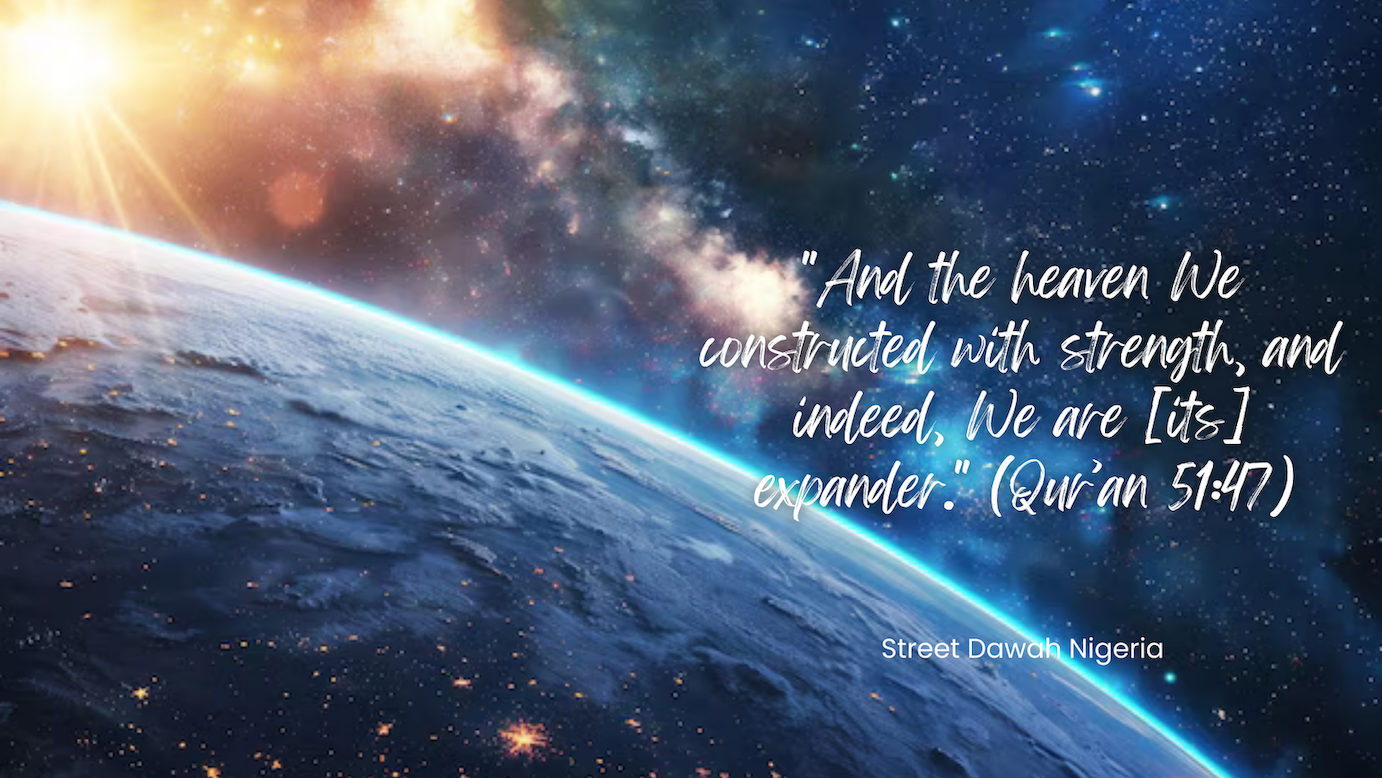
“And the heaven We constructed with strength, and indeed, We are [its] expander.”
— Surah Adh-Dhariyat (51:47)
Scientific Insight
The idea that the universe is expanding was first introduced by astronomer Edwin Hubble in 1929. He observed that galaxies are moving away from each other, suggesting that space itself is stretching. This was a monumental shift in our understanding of the cosmos and formed the basis of the Big Bang theory.
The Quranic verse above, revealed over 1400 years ago, uses the Arabic word “مُوسِعُونَ” (mūsi‘ūn), which can be translated as “expanding” or “We are making it expand.” This aligns strikingly with modern astrophysics.
References
- Hubble, E. (1929). A relation between distance and radial velocity among extra-galactic nebulae. Proceedings of the National Academy of Sciences.
- NASA. (2021). Universe Expansion
2. The Protective Atmosphere
Quranic Verse
“And We made the sky a protected ceiling, but they turn away from its signs.”
— Surah Al-Anbiya (21:32)
Scientific Insight
Earth’s atmosphere is essential for life. It shields us from harmful solar radiation, burns up most meteoroids before they reach the surface, and helps maintain the planet’s temperature balance.
This “protected ceiling” described in the Quran is a poetic but accurate description of the atmospheric layers, particularly the ozone layer and magnetosphere, which deflect solar winds and radiation.
References
- NASA Earth Observatory. (2009). The Atmosphere: Getting a Handle on Carbon Dioxide
- National Geographic. (2020). Atmosphere layers and protection.
3. The Origin of Life from Water
Quranic Verse
“And We made from water every living thing. Then will they not believe?”
— Surah Al-Anbiya (21:30)
Scientific Insight
Water is the essential component for all known forms of life. Modern biology confirms that all living organisms need water for basic functions such as nutrient transport, temperature regulation, and biochemical reactions.
In origin-of-life studies, water is considered a key medium for the formation of organic molecules. The Quran’s emphasis on water as the source of life aligns with these findings.
References
- Chaplin, M. (2001). Water: its importance to life. Biochemical Society Transactions.
- NASA Astrobiology Institute. (2018). Follow the Water campaign.
4. The Mountains as Pegs
Quranic Verse
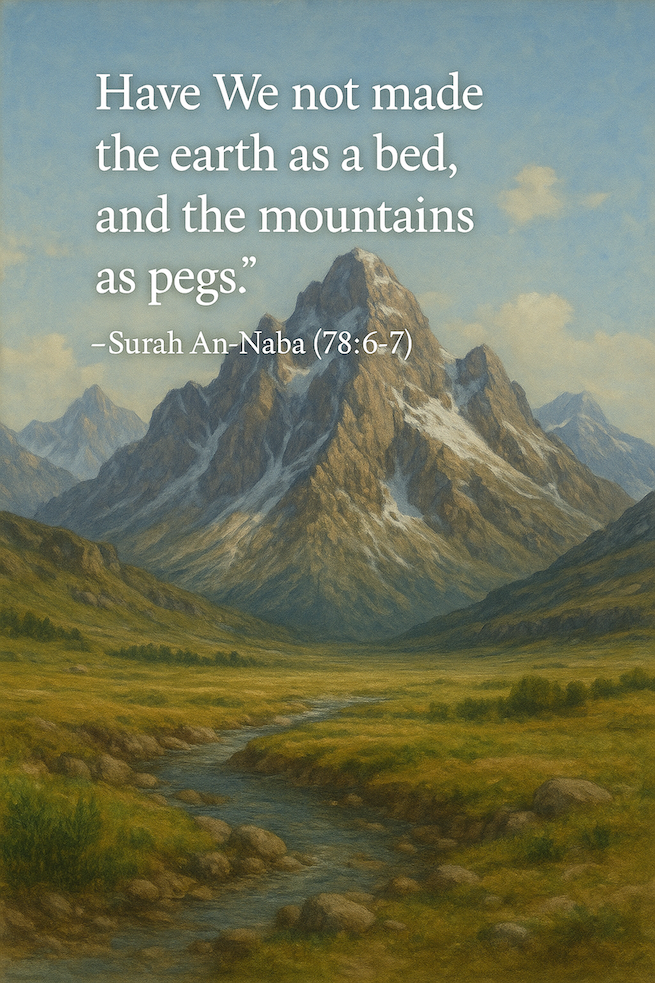
“Have We not made the earth as a bed, and the mountains as pegs?”
— Surah An-Naba (78:6-7)
Scientific Insight
The Quran describes mountains as “pegs” (awtād), an analogy that is eerily similar to their geological function. Mountains have deep roots that stabilize the Earth’s crust, similar to pegs anchoring a tent.
This concept is supported by the theory of plate tectonics, where the movement and collision of Earth’s plates lead to the formation of mountain ranges with deep underground foundations.
References
- Press, F., & Siever, R. (2000). Understanding Earth. Freeman and Company.
- USGS. (2021). Plate Tectonics and Mountain Building.
5. The Development of the Human Embryo
Quranic Verse
“We created man from a drop of mingled fluid to test him…”
— Surah Al-Insan (76:2)
“Then We made the sperm-drop into a clinging clot, and We made the clot into a lump, and We made from the lump bones, and We covered the bones with flesh…”
— Surah Al-Mu’minun (23:13-14)
Scientific Insight
These verses outline the stages of human embryonic development, from fertilization to the formation of flesh and bones. Although not written in medical jargon, the descriptions correspond to modern embryology, which confirms these phases occur sequentially.
The “clinging clot” (‘alaqah) stage can be interpreted as the implantation phase when the embryo attaches itself to the uterine wall, an image that fits modern microscopic observations.
References
- Moore, K.L., Persaud, T.V.N., & Torchia, M.G. (2013). The Developing Human: Clinically Oriented Embryology.
- Levenson, D. (2001). Science and Religion: Reconcilable Differences? Time Magazine.
6. The Dual Nature of Seas
Quranic Verse
“He released the two seas, meeting [side by side]; Between them is a barrier [so] neither of them transgresses.”
— Surah Ar-Rahman (55:19-20)
Scientific Insight
In oceanography, the phenomenon of halocline or thermocline is well-documented. When two seas or water bodies meet, differences in salinity, temperature, and density can prevent them from mixing completely.
One famous example is where the Atlantic Ocean and the Mediterranean Sea meet at the Strait of Gibraltar. Their distinct properties create a visible boundary, a fact that matches the Quranic reference.
References
- UNESCO. (2009). Ocean Mixing and Climate Change.
- The National Oceanic and Atmospheric Administration (NOAA). Salinity and Ocean Currents.
7. Iron Sent Down to Earth
Quranic Verse
“We sent down iron, in which is strong material, as well as many benefits for mankind…”
— Surah Al-Hadid (57:25)
Scientific Insight
Iron is not native to Earth in the way other elements are. Studies in astrophysics reveal that iron is formed in massive stars through nuclear fusion and is spread through space when those stars explode in supernovae. This material eventually became part of the Earth during its formation.
The Quran’s use of the term “sent down” is remarkably accurate in this context—it reflects iron’s extraterrestrial origin.
References
- Clayton, D.D. (1983). Principles of Stellar Evolution and Nucleosynthesis.
- NASA (2019). How Iron Came to Earth.
8. The Bee and Honey Production
Quranic Verse
“Then eat from all the fruits and follow the ways of your Lord laid down [for you]. There emerges from their bellies a drink, varying in colors, in which there is healing for people…”
— Surah An-Nahl (16:69)
Scientific Insight
Bees collect nectar, digest it with enzymes, and regurgitate it to produce honey, which has known antibacterial and antifungal properties. Modern science confirms that honey contains antioxidants, vitamins, and healing compounds used in traditional and modern medicine.
The Quran mentions both the process (“from their bellies”) and the therapeutic benefits of honey—a remarkably accurate depiction.
References
- Bogdanov, S. et al. (2008). Honey in Traditional and Modern Medicine. Journal of ApiProduct and ApiMedical Science.
- National Institutes of Health (NIH). Honey and Wound Healing.
9. The Water Cycle
Quranic Verse
“And We sent down rain from the sky in a measured amount and settled it in the earth. And indeed, We are able to take it away.”
— Surah Al-Mu’minun (23:18)
Scientific Insight
The water cycle involves evaporation, condensation, precipitation, and infiltration. The Quran describes rain as sent in “measured amounts,” aligning with the delicate balance in hydrological systems that maintain life.
Moreover, the verse’s mention of water infiltrating the earth matches what we know about groundwater recharge.
References
- USGS. (2020). The Water Cycle.
- Gleick, P.H. (1993). Water in Crisis: A Guide to the World’s Fresh Water Resources.
Conclusion: A Book Beyond Time
The Quran’s insight into natural phenomena—ranging from the expanding universe to the intricacies of embryonic development—is nothing short of astounding. These descriptions, made over 1,400 years ago in the deserts of Arabia, align with modern scientific discoveries made only in recent centuries. This harmony between scripture and science is not coincidental. It points to something far greater.
The Quran refers to these verses as “signs” (āyāt)—not merely to impress, but to awaken the heart and mind. These signs urge the reader to reflect, to inquire, and ultimately, to recognize that this Book could not have been authored by a human being of the 7th century.
Such precision, beauty, and foresight testify that the Quran is not the product of guesswork or coincidence, but a revelation from the Creator of the heavens and the earth.
If these truths resonate with you, we invite you to read the Quran with an open heart and open mind. Not only is it a source of divine wisdom, but it is also a personal message to every seeker of truth—a message of guidance, mercy, and hope.
“Then do they not reflect upon the Qur’an? If it had been from [any] other than Allah, they would have found within it much contradiction.”
— Surah An-Nisa (4:82)
Explore More thought Provoking Articles
The Uniqueness of the Qur’an: Why It’s Not Just Another Book
The Uniqueness of the Qur’an: Why It’s Not Just Another Book Introduction: A Book That Changed the World Throughout human history, countless books have been written, revered, and forgotten. Some have shaped nations, others have inspired revolutions, and many have...
7 Powerful Reasons the Biography of Prophet Muhammad ﷺ Is the Most Authenticated in History
7 Powerful Reasons the Biography of Prophet Muhammad ﷺ Is the Most Authenticated in History Introduction: A Beacon of Truth in a Fog of Legends In a world teeming with legends, religious icons, and shadowy figures from the past, Prophet Muhammad ﷺ stands out as a man...
Why Islam Is the Most Rational Path to God – 9 Core Principles Explained
Islam: A Clear, Rational Path to God – Understanding the Core Principles Introduction: Finding Clarity in a Confusing World In today’s world, spirituality often feels vague, mystical, or even contradictory. Many seekers are overwhelmed by complexity—multiple gods,...
Dawah: Compassion in Action, Not Compulsion
Dawah: Compassion in Action, Not Compulsion A Divine Invitation Through Love, Not Pressure "Invite to the way of your Lord with wisdom and good instruction, and argue with them in a way that is best."— Qur’an 16:125 Introduction: Dawah as a Gift, Not a Burden Imagine...
Miracles of Nature in the Quran: Scientific Insights and Timeless Wisdom
Miracles of Nature in the Quran: Scientific Insights and Timeless Wisdom Introduction The Quran encourages us to observe and reflect on the signs of the Creator in the natural world. Remarkably, many of these signs align with scientific realities discovered centuries...
The Universe: Evidence of Chaos or the Signature of a Single, Intelligent Designer?
The Universe: Evidence of Chaos or the Signature of a Single, Intelligent Designer? Introduction Step outside—observe a cloud drifting by, the veins in a single leaf, or the vastness of the star-studded night. Every aspect of nature, both colossal and minuscule,...
Street Dawah Nigeria
is a registered non-profit organization registered in Nigeria (RC:137945)
streetdawahnigeria@gmail.com
+234 906 717 7083