
Islam: A Clear, Rational Path to God – Understanding the Core Principles

Introduction: Finding Clarity in a Confusing World
In today’s world, spirituality often feels vague, mystical, or even contradictory. Many seekers are overwhelmed by complexity—multiple gods, unclear doctrines, or rituals with no clear purpose. In contrast, Islam offers a faith built on clarity, logic, and direct connection with God.
At its core, Islam: A Clear, Rational Path to God invites us to understand our Creator through reason, purpose, and lived experience. There’s no mystery for the sake of mystique—only a direct, practical, and fulfilling path that brings the mind, heart, and soul into harmony.
Why Rationality Matters in Faith
Islam doesn’t ask believers to shut off their minds to submit in blind faith. In fact, the Qur’an constantly invites reflection, asking questions like:
“Do they not reflect upon themselves?” (Qur’an 30:8)
“Will they not then reason?” (Qur’an 36:62)
From the very beginning, Islam has encouraged reason, logic, and investigation as tools for discovering the truth. Faith is not a rejection of the intellect—it’s the fulfillment of it.
The Nature of God in Islam: One, Eternal, and Merciful
The Concept of Tawheed (Oneness of God)
The central belief in Islam is Tawheed—that there is only one God, with no partners, intermediaries, or incarnations. This concept is elegant in its simplicity and profound in its implications. It provides:
- A direct relationship with the Creator.
- No confusion between Creator and creation.
- Absolute monotheism, free from human manipulation.
God’s Attributes: Beyond Human Limitations
God in Islam is:
- All-Knowing yet merciful.
- All-Powerful yet loving.
- Unseen, beyond the physical, yet closer than your jugular vein (Qur’an 50:16).
This balance allows believers to revere without fear, worship without intermediaries, and connect without confusion.
Revelation with Purpose: The Role of the Qur’an
A Divine Message Preserved with Clarity
The Qur’an is the final revelation from God—unchanged for over 1,400 years, memorized by millions, and consistent in its message of divine unity, purpose, and ethics.
“This is the Book in which there is no doubt…” (Qur’an 2:2)
The Qur’an’s Rational Appeal to the Intellect
Unlike mythological scriptures, the Qur’an:
- Speaks directly to the human mind.
- Uses logical analogies and scientific observations.
- Challenges readers to verify and reflect on its message.
The Role of the Prophet Muhammad ﷺ as a Rational Guide
A Life Rooted in Justice, Simplicity, and Truth
Prophet Muhammad ﷺ wasn’t a mysterious figure claiming divine status. He was:
- A merchant known for honesty.
- A leader praised for justice.
- A husband and father who lived humbly and compassionately.
His Teachings for Mind and Soul
His life modeled:
- Spiritual discipline
- Emotional intelligence
- Political fairness
- Moral clarity
He taught by example, guided by the Qur’an, and preserved his words and actions with historical precision—making Islam not just believable, but livable.
Core Beliefs That Appeal to the Intellect
Belief in One God, Angels, Prophets, Books, the Afterlife, and Destiny
Islam’s six articles of faith are cohesive and comprehensive:
- Belief in One God – Supreme, singular, and just.
- Angels – Created by God for specific purposes, not worshipped.
- Divine Books – Messages revealed throughout history.
- Prophets – From Adam to Muhammad ﷺ, all human, none divine.
- Day of Judgment – Accountability based on deeds.
- Divine Decree – God’s knowledge and control with human free will.
No Blind Faith – Islam Encourages Questioning and Learning
“Ask those who know if you do not know.” (Qur’an 16:43)
Islam supports intellectual curiosity. Doubts aren’t punished—they’re explored, answered, and resolved through reason and revelation.
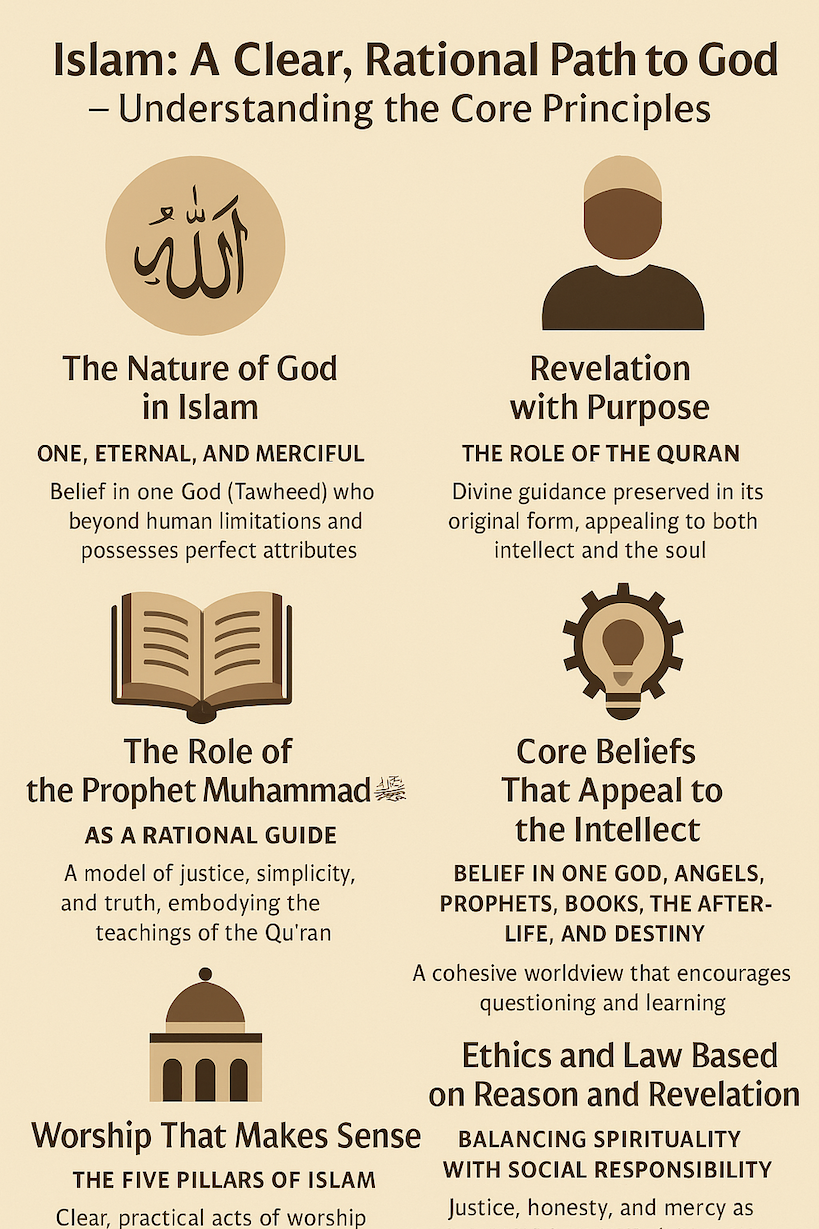
Worship That Makes Sense: The Five Pillars of Islam
Islam’s practice is clear, structured, and purposeful. The Five Pillars of Islam provide a complete framework for spiritual connection:
1. Shahada (Testimony of Faith)
- “There is no god but Allah, and Muhammad is His Messenger.”
- Declares monotheism and commitment to truth.
2. Salah (Prayer)
- Five daily prayers at specific times.
- A physical and spiritual reset to connect with God regularly.
3. Zakah (Charity)
- 2.5% of one’s wealth given annually to the poor.
- Encourages social justice and economic balance.
4. Sawm (Fasting in Ramadan)
- From dawn to sunset.
- Builds discipline, empathy, and spiritual focus.
5. Hajj (Pilgrimage)
- A journey of equality and worship.
- Reenacts the footsteps of Abraham, shared by multiple faiths.
Ethics and Law Based on Reason and Revelation
Balancing Spirituality with Social Responsibility
Islam isn’t just about rituals. Its teachings govern:
- Business ethics
- Family dynamics
- Human rights
- Environmental care
Justice, Honesty, and Mercy as Core Values
Islamic law (Shariah) is built to:
- Promote justice.
- Protect life, property, faith, intellect, and family.
- Uphold compassion and moderation over extremism.
Islam’s Approach to Doubt and Evidence
Intellectual Proofs of God’s Existence in the Qur’an
The Qur’an frequently points to:
- The heavens and the earth.
- The alternation of night and day.
- Human development and the soul.
“We will show them Our signs in the universe and within themselves until it becomes clear to them that this is the truth…” (Qur’an 41:53)
Invitation to Reflect, Not Just Obey
Islam doesn’t shy away from skepticism. It answers with:
- Historical evidence
- Scientific phenomena
- Logical consistency
How Islam Simplifies Life, Not Complicates It
Clear Purpose of Life and Afterlife
Islam teaches:
- We were created to worship God and serve humanity.
- Life is a test; the hereafter is the reward.
“And I did not create mankind and jinn except to worship Me.” (Qur’an 51:56)
Harmonizing the Heart, Mind, and Body
Islam aligns:
- Mind – through reflection and learning.
- Heart – through prayer and remembrance.
- Body – through purification and discipline.
What Converts and Seekers Say About Islam’s Clarity
Quotes from Reverts on Finding Logic and Peace
- “Islam answered questions I didn’t know how to ask.”
- “I didn’t convert out of emotion—I converted because it just made sense.”
- “There’s nothing vague in Islam. It’s a manual for life.”
Stories of Intellectual Journeys to Islam
Doctors, philosophers, engineers, and artists around the world say:
- Islam offered clarity in a world of confusion.
- It challenged them to think, not blindly follow.
- It brought peace, purpose, and direction.
Conclusion: The Path Is Clear, The Destination Eternal
Islam offers a path not clouded by mythology or contradiction. It speaks to the mind, nourishes the heart, and guides the body. With clear teachings, preserved scripture, and a rational worldview, Islam remains the most coherent and compelling path to God.
If you’re seeking truth that aligns with reason and leads to peace, Islam is the clear, rational path you’ve been looking for.
Explore More thought Provoking Articles
The Uniqueness of the Qur’an: Why It’s Not Just Another Book
The Uniqueness of the Qur’an: Why It’s Not Just Another Book Introduction: A Book That Changed the World Throughout human history, countless books have been written, revered, and forgotten. Some have shaped nations, others have inspired revolutions, and many have...
7 Powerful Reasons the Biography of Prophet Muhammad ﷺ Is the Most Authenticated in History
7 Powerful Reasons the Biography of Prophet Muhammad ﷺ Is the Most Authenticated in History Introduction: A Beacon of Truth in a Fog of Legends In a world teeming with legends, religious icons, and shadowy figures from the past, Prophet Muhammad ﷺ stands out as a man...
Dawah: Compassion in Action, Not Compulsion
Dawah: Compassion in Action, Not Compulsion A Divine Invitation Through Love, Not Pressure "Invite to the way of your Lord with wisdom and good instruction, and argue with them in a way that is best."— Qur’an 16:125 Introduction: Dawah as a Gift, Not a Burden Imagine...
“Revealed Truths: Scientific Wonders in the Quran That Defy Time”
“Revealed Truths: Scientific Wonders in the Quran That Defy Time” Introduction The Quran is a book revered not only for its spiritual guidance but also for its profound references to the natural world. These verses, often poetic and metaphorical, contain layers of...
Miracles of Nature in the Quran: Scientific Insights and Timeless Wisdom
Miracles of Nature in the Quran: Scientific Insights and Timeless Wisdom Introduction The Quran encourages us to observe and reflect on the signs of the Creator in the natural world. Remarkably, many of these signs align with scientific realities discovered centuries...
The Universe: Evidence of Chaos or the Signature of a Single, Intelligent Designer?
The Universe: Evidence of Chaos or the Signature of a Single, Intelligent Designer? Introduction Step outside—observe a cloud drifting by, the veins in a single leaf, or the vastness of the star-studded night. Every aspect of nature, both colossal and minuscule,...
Street Dawah Nigeria
is a registered non-profit organization registered in Nigeria (RC:137945)
streetdawahnigeria@gmail.com
+234 906 717 7083